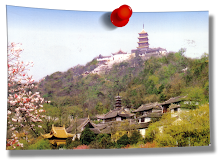
Deltiology (from Greek δελτίον, deltion, diminuitive of δέλτος, deltos, "tablet, letter"; and -λογία, -logia) is the study and collection of postcards. Compared to philately, the iden- tification of a postcard's place and time of production can often be an impossible task because postcards, unlike stamps, are produced in a decentralised, unregulated manner. For this reason, some collectors choose to limit their acquisitions to cards by specific artists and publishers, or by time and location.
Glossary of Postcard Terminology - click here * * * Postcard History - click here

103 - Hungary

The Primatial Basilica of the Blessed Virgin Mary Assumed Into Heaven and St Adalbert is an ecclesiastic basilica in Esztergom, Hungary, the mother church of the Archdiocese of Esztergom-Budapest, and the seat of the Catholic Church in Hungary. It is dedicated to the Saint Mary of the Assumption and Saint Adalbert.The building of the present church took place on the foundation of several earlier churches. The first was built by Stephen I of Hungary between 1001–1010 (as the original Saint Adalbert church), the first cathedral in Hungary, which was burned down at the end of XII century. It was rebuilt, and even survived the Mongol invasion of Hungary. However, in 1304, Wenceslaus III, a probable candidate for the Hungarian throne, sacked the castle and the church. It was repaired in the the following years. The archbishops of the XIV and XV century ornated the church more, made some altering and a huge library was also added, the second most significant one in the country. It was ruined again under Turkish rule, in 1543. In 1820, the Archdiocese was restored and archbishop Sándor Rudnay decided to restore Esztergom's status as mother church of the country.
The architect was Pál Kühnel and the lead contractor was János Packh. The foundation-stone was laid and work began in 1822. The Bakócz chapel was carefully disassembled (into about 1,600 pieces) and was moved 20 metres away from its original location and attached to the new basilica. In 1838 Packh was murdered, so József Hild was placed in charge of construction. He completed it in Classicistic style. Under the next archbishop, János Scitovszky, the upper church was completed and dedicated on August 31, 1856. The 1856 consecration ceremonies featured the premiere of the Missa solennis zur Einweihung der Basilika in Gran (Gran Mass), composed and conducted by Franz Liszt. The final completion of the cathedral took place twelve years later in 1869.

102 - Hungary

Esztergom (known by alternative names) is a city in northern Hungary, about 50 km north-west of the capital Budapest. It lies in Komárom-Esztergom county, on the right bank of the river Danube, which forms the border with Slovakia there.
Esztergom was the capital of Hungary from the 10th till the mid-13th century and it was the Royal Seat until King Béla IV of Hungary moved to Visegrád and later to Buda.
Esztergom still is the seat of the prímás (Primate) of the Roman Catholic Church in Hungary. The city has the Keresztény Múzeum, the largest ecclesiastical collection in Hungary. Its cathedral, Esztergom Basilica is the largest church in Hungary.
One of the newest sights of Esztergom is the Mária Valéria bridge, connecting Esztergom with the city of Štúrovo in Slovakia. Originally it was inaugurated in 1895, but the retreating German troops destroyed it in 1944. It was rebuilt in 2001 with the support of the European Union.

101 - Hungary

In the Pannonhalma Archives of the Benedictine Archabbey we can find one of the richest and most valuable collections of documents from the first centuries of the Hungarian statehood. It includes the monastery's interpolated charter (1001-1002) from Saint Stephen, the founding charter of the Tihany Abbey (1055), the first known written text to include Hungarian words and phrases. The records of the medieval Pannonhalma, a monastery with the rights to issue official documents (locus authenticus), and the records of the Bakonybél, the Tihany and the Dömölk abbeys constitute separate entities. The archive collects documents from the archabbot's office, the Theological School and the former Teacher Training School of the order, the former and current secondary schools, the dependent Benedictine houses, the finance offices of the Archabbey, and from the documentation of the parishes that belong to the so called Territorial Abbey: a quasi-diocese under the authority of the Archabbey. Partially as deposit, partially as inheritance, the archives of the Guary, the Somogyi, the Chernel, the Kende, the Erdődy and the Lónyay families came into our collection. The amount of the archive's holdings is 192 running metres.

100 - Hungary

The Danube Bend (Dunakanyar in Hungarian), marks a point in the Danube where the river literally makes a sharp bend (the direction of the current does not change direction though). The Danube Bend is not a town, but a region or certain length of the Danube which is dotted by a string of small riverside towns north of Budapest. Both Hungarians and foreign tourists find this a popular excursion destination. Just after Esztergom, about 40km (25 miles) north of Budapest, the Danube swings abruptly south. This marks the beginning of the Danube Bend region if approaching from the north. The river then swings sharply north again just before Visegrád, and then heads south once more before reaching Vác. Vác typically marks the end of the Danube Bend. The charming towns along the meandering Danube Bend - particularly Szentendre, Visegrád, and Esztergom - can easily be vistied on day trips from Budapest since they are all close to Budapest.

099 - Hungary

The Primatial Basilica of the Blessed Virgin Mary Assumed Into Heaven and St. Adalbert is an ecclesiastic basilica in Esztergom, Hungary, the mother church of the Archdiocese of Esztergom-Budapest, and the seat of the Catholic Church in Hungary. It is dedicated to the Saint Mary of the Assumption and Saint Adalbert.
It is the tallest building in Hungary and the 18th biggest church in the world. Its inner area is 56,000 m². It is 118 m long and 49 m wide. It has a reverberation time of more than 9 seconds. Its dome, forming a semi-sphere, is situated in the middle, and it has 12 windows. It is 71,5 m high inside, with a diameter of 33,5 metres, and is 100 m high from outside, counted from the crypt.
The altarpiece (13,5×6,6 metres, depicting the Assumption of the Blessed Virgin Mary, by Michelangelo Grigoletti) is the largest painting in the world painted on a single piece of canvas.
The basilica is also known for Bakócz Chapel (named after Tamás Bakócz), built by Italian masters between 1506-1507 out of red marble of Süttő, its walls adorned with Tuscan Renaissance motifs. It is the most precious remaining example of Renaissance art in Hungary.
The huge crypt, built in Old Egyptian style in 1831, is today the resting place of late archbishops, among others, József Mindszenty.

098 - Hungary

The building of the Hungarian Culture Foundation is located in the heart of the Buda Castle, near the Matthias Church and the Fishermen's Bastion. The house of the Foundation is an impressive palace of new gothic style, built in the early 20th century.
In the frameworks of its activities focusing on Hungarians living outside the country's borders, the Foundation fosters the broadening of cultural relationships among prominent Hungarian personalities and public living all over the world.
The central concept of the initiatives of the Foundation is the "meeting of regions". In this spirit we organize the Day of Hungarian Culture, the Cartoon Festival, the Smile-days of Buda, the Day of Poetry, the Days of Carpathian Basin, the Honey-days of Buda, and other events all year round.
The Hungarian Culture Foundation produces the financial sources for its mission through entrepreneurial work. Our magnificent setting is available to those who look for an ideal scene for a ball, a reception, a party, a conference, a training course, a concert, or a performance. In the ornate hall of our building, the Foundation arranges fine arts, business and trade exhibitions. This facility of great traditions also offers offices to let. Furthermore, the Foundation runs a 16-room two-star hotel with a family atmosphere. In the rooms of the Hotel Kulturinnov there are private showers, telephones and mini-bars. Room prices include buffet breakfast.
In the building of the Hungarian Culture Foundation are housed several restaurants, such as the Jankó Contemporary Hungarian Restaurant, the Matthias Restaurant, and Fortuna Restaurant; drink bars are also at our guests' service. In the Fortuna Passage, which belongs to the house of the Foundation, one can browse special shops such as Judit Józsa's Pure Source Gallery offering hand-made ceramics and sculptures, the Fortuna Antique Shop, as well as a Fashion Store. In the cellar of the building you can visit the House of Hungarian Wines, where you can taste the most famous wines of all 22 Hungarian wine-regions.

097 - Hungary

Pannonhalma's most notable landmark, the Benedictine Pannonhalma Archabbey, one of the oldest historical monuments in Hungary, can be found next to the town, on top of a hill (282 m). Saint Martin of Tours is believed to have been born at the foot of this hill, hence its former name, Mount of Saint Martin (Márton-hegy in Hungarian), from which the monastery occasionally took the alternative name of Márton-hegyi Apátság. This is the second largest territorial (ie., approx. sovereign) abbey in the world, after the one in Monte Cassino.
The library was finished in the first third of the 19th century. The longitudinal part of the building was planned and built by Ferenc Engel in the 1820s. Later János Packh was commissioned with extending the edifice, and the oval hall is his work. Joseph Klieber, a Vienna master was asked to ornament the interior of the building.
On the four sides of the oval hall's ceiling the allegories of the four medieval university faculties can be seen: Law, Theology, Medicine and the Arts. The holdings of the library have been increasing ever since. Manuscripts from the time of Saint László have been catalogued in Pannonhalma. As of today, 450.000 volumes are kept in the collection.

096 - Hungary

The Citadel (Fellegvár) and the Lower Castle The Visegrád double castle system is one of the castles built by Béla IV recognizing the consequences of the Mongol invasion. The fortress preserved its significance until the Turkish invasions.
The Citadel had a multifunctional role: it was protecting the valley of the Danube, it was controlling the main commerical route between Buda and Esztergom, and also served as a custom’s house. The fortress consisted of two parts.
The construction of the Lower Castle started under the reign of Béla IV around 1247. It was unique, as the fortress was not located next to the road differing from the common traditions, but the road was crossing the territory of the castle. The most interesting part of the Lower Castle is the so called Solomon Tower. The Tower was named after a false story, stating that Solomon was guarded in this Tower after loosing in the battle for the throne against King Saint László and Géza.
This unique Hungarian building was constructed based on a southern-German design. Under the reign of Louis the Great King of Hungary, the famous bell-founder Konrád Gaal was operating in the fortress. Today the Tower is hosting a five-storey museum, introducing the history of Visegrád to its visitors.
In 1246 Béla IV started the construction of the Citadel on an area with outstanding geographical characteristics, by the using the money from the family jewels of his wife, Mária Lascaris to build a refugee for the Dominican Order nuns living on the ’Rabbits Island’ (today’s Margaret Island).
At that time the plan of the fortress was triangle-shaped, with two towers.
The Old Tower was erected at a location most at risk, and the Gate Tower protected the southern entrance. The significance of the fortress considerably improved during the Anjou era. Once Charles Robert obtained the fortress from Máté Csák, he moved the royal court here in 1323.
The Visegrád Citadel hosted the famous Royal Summit of Kings, and the first Anjou King died in the castle in 1370. The Saint Crown of Hungary was guarded here. When Louis the Great became the King of Poland in 1370, the Polish crown was also stored in the castle. The palace wings and a new external wall was erected during the Anjou reign. Sigismund of Luxemburg extended the fortification with a third set of walls and carried out several lavish constructions.
Following the Turkish reign, after the liberation of Buda in 1686 the Habsburgs conquered the fortress after a 5-day siege. Due to the dissolution of the border castle system the fortification became unwanted and was left to ruin.
The excavation and reconstruction activities started in 1871 and are still underway today.